Thursday, February 10, 2011

today : A wizard deal for Osborne's chums


So, using my magical mystical (even wizard-like) powers, I managed to predict what would happen with 'Project Merlin'

If the Daily Mail says stuff like this about a Tory government, then maybe there's a problem Independent You kind of expect the Indie to be unbiased towards the Tories

But the FT tends to just tell it like it is. "The accord effectively saw Mr Osborne give a green light to banks to pay multibillion-pound bonuses in exchange for a promise to increase lending to small companies by 15 per cent from £66bn to £76bn.

Reuters summed it up for the rest of the world to report

The Guardian well, they would say that wouldn't they?

Wall Street Journal "But the truce—the product of more than two months of negotiations between government and industry leaders amid heated debate over the role of banks in society—doesn't require the banks to do much beyond what they're already doing."

FT again on Cameron's multiculturalism stance.

Is David Cameron not a PR specialist?

Sunday, February 06, 2011

today : David Cameron ruins my weekend


Please. Just once. Just one weekend, or even one day, when I turn on the TV and don't find some politician, obsessed with controlling the news cycle. There they are day in and day out. Announcing new initiatives, promoting policy directions, trumpeting their every action (or inaction for that matter) as an achievement. Forever feeding the feral beast its ration of topics to discuss and proposals to dissect.

Much of the time I can kind of ignore it. Most of what they feed the beast is just white sugar: empty calories. The here today, gone tomorrow news-cycle stop-gaps. The increasingly fake-looking and annoying Clegg restates some minor aspect of policy, some junior housing minister says something about houses, things that might go in a green paper maybe possibly or not.

But I can't ignore things that I think are just wrong. Things that are not just ruining my day or my weekend, but ruining peoples' lives. And my fate in the past months has been to be bombarded with stuff which is, however empty sometimes, just plain wrong. And it keeps on coming.

This weekend I was forced into a response. Like an unannounced visitor or a stalker, I couldn't ignore it and switch over to the footie. Cameron went on TV to peddle his utter nonsense about Islam and British identity.

I can't even make the time to explain how mind-bendingly wrong the content of his speech was. It was staggeringly wrong on every single level.

But the question remains why? Why now?

Is it something to do with Bob Diamond's 9 million quid bonus, or the fact that the IFS criticised Osborne's policies? Is it the fact that the inflation and employment figures are pretty poor? Is it the fact that MPs were complaining about their expenses during the week? What is in the air that is even worse bad news? Is there something buried on page 12 that shows the government in a bad light. Is one of the Sunday papers sitting on some phone-hacking gold. What flatlining figures are announced on Monday?

Or is the fact that, when the Daily Mail, Express and Telegraph are starting to fill their pages with critical, questioning headlines and stories only 9 months into a government term, there is a real danger that the strategy is crumbling at the edges.

And one sure fire way to get the Mail, Express and Telegraph back on side is to pander to their basest of impulses. Get them on about immigration, Muslims, terrorism. Feed their racism and xenophobia. Big up their rose-tinted misty eyed, almost entirely false vision of some mythical lost white Britain/England. A couple of months out from the local elections and Clegg's big electoral reform vote, start to wind up the old retrenched Tory rhetoric.

And ruin my weekend.

today : keep an eye on this name


Chuka Umunna. You'll be seeing it & hearing it a lot more in the future.

Tuesday, February 01, 2011

today: bread, freedom and social justice


When I called, in my recent Christmas message to the world, for people to take action, little did I know that the citizens of North Africa would take me so directly at my word. Actually, I do realise that some anonymous person on a little read blog did not cause the Tunisian and Egyptian uprisings. At any given moment there are always revolutions in train, or ready to take place. Many of them are little reported. People die for principle every day and are never commemorated. You also don't need to be Mystic Meg to see that things are reaching a tipping point in many areas of the world.

Bread, freedom and social justice. It's always about these things. The best thing any dictator can do to maintain power and is to give their people these three simple things. If they did, they might not be overthrown, put on trial or shot against a wall. I guess most dictators are so blinkered and stupid that they don't see it.

Sunday, January 30, 2011

today: four aeroplanes


The Harrier Jump Jet

Even though I can picture it in my mind, I suspect that one of my earliest memories is not actually mine. I think it's probably a collective family memory - something that was oft repeated and supported by things I've seen on TV.

I am very young and we are all sitting on the roof the car looking across other cars parked in neat rows, and a crowd of people downwards into a green idyllic valley. We are at an air show. Suddenly, from behind a line of trees a noise begins. It's a whining roar that swells in volume until it is almost deafening. And then a blue aeroplane appears. It rises - miraculously - vertically from behind the trees and continues lifting straight up into the sunny sky, as if on a fishing line or attached to a crane. The crowd gasp in delight and excitement. Some people begin applauding. Then it stops. It just sits there in the sky. The noise is too loud for my sensitive young ears and I think I might have started to cry. The plane, standing still in the air, wavers a little and then suddenly zooms, nose first, away.

It was, of course, a Harrier jump jet. And the thing was, even if this time I wasn't actually there, or was too young to remember, I've seen Harriers do the same thing many times since. Each time it is miraculous and exciting. It is, after all, a plane that can rise vertically from the ground into the sunny sky. Another time I remember seeing a Harrier fly horizontally towards where the air-show crowd was gathered and then just stop in mid-air as if it had hit an invisible wall. I've seen a pair of Harrier's circling each other, nose facing nose, as if they were dancing a chaste kind of tango, or as if they were Judo players waiting for the moment of attack.

The Harrier was so exciting because you can't believe your eyes. You know that, like proverbial sharks, aeroplanes need speed and forward motion to stay alive. When a helicopter hovers you can see the blades whirring away and make the connection in your mind that it is the rotor that is holding it in the air. But a Harrier just sits there above the ground with no visible means of support. It can even fly backwards, and whether young or old, it kind of does your head in.

And always accompanied by the noise. That whining, roaring sound that blasts your ears and rumbles your insides.

Late last year government cuts scrapped the UK's Harriers. I watched the live coverage as the pilots, in formation, climbed out of their planes for the last time, leaving them static on the runway as they walked together towards a final parade. None of the pilots looked back. I imagine they got an order from command to remain stoic, but I also guess none of them could bear to turn their heads.


Concorde

Leeds/Bradford airport was always part of my world. It was about 5 miles from our house growing up and it is still only about 6 miles from where I live today. In our old house we could hear the planes taking off and their flight path went directly over the valley our house overlooked. Out of my childhood bedroom window we could watch as they climbed across the sky before slowly turning away into the distance.

It's an odd airport - small and provincial. I have taken connecting flights from there in recent years and had to walk to prop a driven aircraft before climbing a short staircase onto the plane. It felt like the 1930s. Big airports always feel like places that stand outside of real geography. They are the portals of globalisation. Places like Atlanta, O'Hare, or Heathrow or CDG or Schipol are big, exciting, intimidating places. Sprawling towns occupied by excited transients from all corners of the globe. LBA doesn't feel like that. It's like a lego version. A little underused, a little windswept. Every half an hour fifty or a hundred people roll up to or emerge from its low doorways. If you collect or drop off a friend or relative you can almost drive up to the door, as if you were collecting them from their house.

Some years ago the airport had its runway extended. The road along the west side of the airport now goes underneath the runway extension and I drive through this short tunnel often. Sometimes, approaching the tunnel you can watch a 747 land and then immediately drive underneath it, knowing that you are maybe 30 feet from the wheels as they rumble above your head.

The main benefit of having an extended runway was that for a while, LBA was one of the rare provincial airports that could handle Concorde. A few times a year a Concorde would come along. Sometimes they toured provincial airports and people could book a short flight - a half-hour Concorde joyride. It was always prohibitively expensive. When we were young we could tell when it was taking off, as it made a noise unlike any other plane. It was fabulously loud. We'd get up and rush to the window or outside into the garden to watch it as it climbed above the valley.

I think most people in the UK love Concorde. It is genuinely iconic - hence the generic name that defines it as unique and special. I don't think we were alone in rushing out to watch it soar across the sky. I remember being at Wimbledon in the 1980s to watch the tennis. Sitting out on court 2, with its open banks of seating, the familiar unique roar emanated from the direction of Heathrow. As an ascending Concorde appeared above SW19 I noticed almost everyone in the crowd avert their eyes from watching Hanna Mandlikova play someone like Catherine Tanvier for a few seconds to watch Concorde as it rose across the skyline.

My most vivid memory of Concorde was from an air show. It was, I think, a last minute addition to the programme - probably on its way to somewhere else and able to fit in a fly-past. We were sitting on top of the car and could see it in the distance to our left. Excitement grew as it approached. As it did it dipped down lower and lower to the ground, until it was flying at only three or four hundred feet. As it reached the airfield where the crowd was gathered it slowly rolled, so as it flew in front of the crowd it tilted away, underside exposed to the onlookers. It was magic. There was Concorde (CONCORDE!) only yards away, flying sideways with one wing almost touching the ground. As it rolled back onto its belly and flew off the crowd cheered.

About 15 minutes later it had turned around and came in again from the other side, repeating the manoeuvre, only this time with it's top-side facing the crowd. And then it was gone.

The A-10 Warthog

I'm lucky. I grew up and still live in a beautiful part of the world. The Yorkshire Dales are literally on my doorstep and the Lake District is only about an hour away. When we were kids we'd all pile in the car and drive into the country for days out or camping holidays. Imagine that. Going on holiday to places that are only only 20 or 30 miles from home.

Days in the country were somehow not complete without the summer idyll of picturesque villages being suddenly and violently shattered by the screaming noise of low-flying jets. The Lightnings, Buccaneers and Tornadoes used the Dales and the Lakes as perfect practice grounds for low flying. There you were, sitting eating an ice-cream or sipping tea outside a country tea shop and the sky would suddenly, thrillingly, be split apart by the racket from low-flying jets speeding across the countryside, just feet above the ground.

It doesn't happen as much these days. It's easy to forget that The Cold War was a pretty militarised time in our history.

I might be conflating a series of memories. It could have been Nidderdale, where the road snakes from the valley-head village of Lofthouse and the hidden limestone gorge at How Stean, along the edge of Gouthwaite reservoir and into Pateley Bridge, but I am sure it was the Lake District.

In the Summer of 1979, we stayed in a cottage on the shores of Bassenthwaite Lake, one of the quietest and least populated lake-shores in Cumbria. Perhaps we'd hiked up the fell above our cottage, or maybe we took the narrow tunnel under the road that led us to the stony shore and were standing at water level. The cottage was one of the very few buildings along the 4 mile length of the lake and the path through the tunnel down to the water was more or less private access to the water. We spent a few afternoons fishing or playing in the water in our inflatable dinghy.

Such details are a little fuzzy, but not the memory of a pair of A-10 jets that suddenly appeared at one end of the lake, flying no more than 30 feet from the surface of the water. They skimmed at enormous speed along the length of the lake before arcing upwards towards the hill that rises about 700 feet and marks the Southern end of the lake. Their engines growled and screamed as they split apart. One jet swooped to the left and one to the right of the hill.

A year or two later, at the same air-show that hosted the Concorde, there was an A-10 parked in the static display. My Dad and I climbed the steps up to a platform to look into the cock-pit. The pilot - a clean cut midwestern-looking American who looked like he was called Chip or Brad, told us all about the history of the plane, including the fact that the pilots referred to it as The 'Warthog'. The A-10 had none of the elegance of a Concorde, but instead was a pretty ugly looking machine. It's uniqueness was the twin jet engines mounted in front of a U-shaped tail, and a short stubby nose. It did indeed look not unlike a Warthog. Squat, powerful and pig-like.

I thought it was great. Having Chip give us a guided tour made me instantly develop a fondness for it. I don't think I'd ever met a proper American before and this made the tour even more memorable.

After that, in the last years of the Cold War, I'd look out for the A10s blasting low across the Dales and the Lakes and felt an affinity for them. It was personal cult plane, unloved by many, but adored by me.

The Vulcan Bomber

I hate war, which amuses me when I think of how much I am smitten with war planes. I never harboured the desire to become a pilot, although I did know a guy at University who was training as a fighter pilot and went on to fly Tornadoes in the first Gulf War. I talked to him a couple of times about planes, but I think he was stunned. I was a goth-looking literature student with a strange haircut and a range of adolescent affectations. He was the complete opposite. Clean-cut, clean living. Organised, disciplined and responsible. I imagine he couldn't believe I was really interested in planes. And in some ways I'm not interested in them. I don't care about the technical specifications and would never risk being thrown into a foreign gaol by ogling or photographing them. I don't aspire to tick them off on a list, or look them up in books. I don't even know much about them apart from some of the names and shapes. But certain planes do for me is what certain cars seem to do for other people. They inspire an emotional response. I am in love with them.

What enchants me is the aesthetics and the visceral excitement. I just love to see these big, noisy, aggressive, impressive machines close up. Even more than that I love the noise.

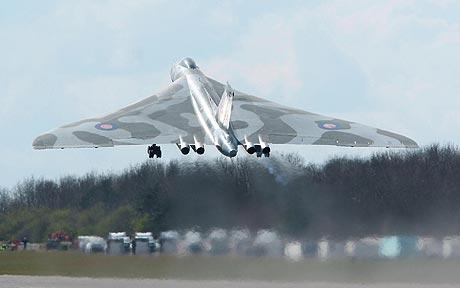
And nothing sounds like a Vulcan bomber.

Climbing into the sky the Vulcan made a hellish basso roar. When the afterburners went on, the engines glowed a deep fiery orange and a low malevolent crackle ripped through the air. It shifted your diaphragm and resonated in your visceral cavity. It was frightening and thrilling and somehow primeval.

Vulcans are beautiful. They have delta wings like Concorde, but a Vulcan's wings are broad and as wide as the body is long. In flight they look like a soaring eagle, the curve of their wings has an almost organic grace.

But their beauty is matched by an indefinable quality. Power. When a Vulcan takes off, despite it's elegant design, there is no mistaking the fact that this is basically a 40 ton block of very solid, very heavy metal. You can tangibly feel the physics involved in getting this huge 100 foot machine to lift off and fly. And of course, the power is mind-boggling. It's something like the equivalent of having 150,000 horse power.

Here's why it's my favourite plane: the Vulcan somehow transmits all of this when you see it flying up close. Lots of planes seem to be effortless as they dive around the skies. The Vulcan appears to wheeze and sweat, like a superheavyweight weight-lifter straining every bone and sinew to put the weights over his head and you can see that the weight is so great that the metal bar is actually bending under the strain.

The paradox is that the take-off is rather serene. Like a kite a Vulcan suddenly catches the air under its giant wings and lifts gently off the ground. But then it can't go any higher without the supreme effort of those massive engines. They slowly grind into life, producing an oily looking trail of what can only be grimy, caustic smoke that reminds me of the belching chimneys of Victorian dark satanic mills. And that's when the great roaring, hulking machine soars into the sky.

They scrapped the Vulcan fleet in the mid-1980s, and only recently a bunch of nutty enthusiasts have restored one until it can again fly. They take it round air-shows. The thing is, they're not really nutty at all, just besotted.


Saturday, January 29, 2011

today : two deaths reported


In a world where people like David Kato are murdered just for being different it's hard to know what to do to influence things. One thing not to do is to randomly slash the budget of the BBC World Service, which - despite its beginnings as the Empire Service and over the years has received criticism - is one sure way of providing an influential and impartial voice to people who don't have local access to unbiased information.

Sean Rossington was different too. This time he wasn't in a country under the influence of bigoted evangelicals, poor educational standards and with retrogressive social attitudes. He was from Lincoln. But he was still killed. They thought his Aspergers made him an easy mark for exploitation, but when it turned out he had no money they stanped him to death.


Thursday, January 27, 2011

today : blow the cobwebs out

by listening to this song. It's Sunset by White Noise Sound.


today : aeroplanes


I am currently writing about my possibly antediluvian love of military aeroplanes. I've not finished the writing bit enough to post, but today was the day that he government scrapped the Nimrod, following their scrapping of the Harrier and I thought I'd mention it.

Bizarrely I am posting a picture of the best plane of them all - The Vulcan bomber.

Monday, January 24, 2011

Today: I come off as a clever-clever superior so-and-so


This is the sentence that jumped out at me:

"Wolper began working on Albertus in 1932 and it swiftly appeared on book jackets, announcing the young Seamus Heaney and William Golding as writers too good to ignore."

There is a problem here. Well, two problems. The use of the adverb 'swiftly' strongly implies that the young Seamus Heaney and William Golding were among the early beneficiaries of the Albertus font, and its use on Faber book jackets. In actual fact, Golding's first published novel was Lord of the Flies in 1954 - 22 years after Albertus was initiated and some 13 years after its adoption in 1941 by Faber, and Heaney wasn't born until 1939 and didn't publish his first collection until 1966 - 34 years after Wolpe's design and 25 years after it was adopted by Faber.

Either the sentence is poorly expressed or the writer is winging the facts and trying to be in command of an area that he knows little about. Switch out the word 'swiftly' for the word 'later' and all is fine.

I'd read about and heard about Simon Garfield's book 'Just My Type'. I remembered Garfield from his excellent book about the rancorous history of Radio 1 (The Nation's Favourite), and thought a book about fonts was potentially interesting.

It turns out that the book is a better idea than it is a book. It has lots of nuggets of history, information and quirky by-ways by the way of font related stuff, but really lacks a narrative of the kind even non-fiction needs. It even looks as if the author has done lots of research up to the point where he had enough material for a book, but really doesn't exude the depth of expertise that we are used to these days in this world of Stephen Pinker, Hawking and writers like Dava Sobel.

Anyway, that's an aside. My real topic is how it only takes one bad sentence. Or one wrong fact, or one moment of sloppiness to undermine the whole of someones work.

I find it hard not to be grumpy and clever-clever superior so-and-so when I see it. The other day I saw a newsreader pronounce the word Berwick (as in the town-on-Tweed) phonetically as Ber-wick. Tonight I saw a scrolling line of news on BBC news 24 reporting that "Senator Gifford's condition downgraded from 'critical' to 'serous'" That's not just a typo but an apostrophe catastrophe, as well as a further typo. What it meant was that the person typing the stuff into the news ticker scrolling software was not aware that Gabrielle Giffords has an 's' on her name all the time. It also meant that nobody checked the typing before it was posted. Even though I was on my own at home I tried hard not to think grumpy superior thoughts.

I make these mistakes myself all the time on my blog and other places. Typos are all over the place if you look. But I am not a professional news ticker typer-inner; neither am I the BBC, or the editor of a widely available and much publicised book (as I write it's #124 on the Amazon chart). In fact I have a kind of typing dyslexia, where my mind sends messages to my fingers that it thinks are perfectly exact, but my fingers automatically reverse certain letter combinations. Sometimes whole strings appear backwards. Curiously I have no such trouble when playing the guitar or piano.

My instant question is: "If he was sloppy on this, then what else?". It could be just a spellchecking error, or he wrote his book using software that automatically switches out words for what it thinks are synonyms. It could be a sentence added in the editing and not properly proofed. Deadlines could have intervened.

It could be any number of things. But what remains is a hazy grasp on the facts, or an inability to write a sentence that expresses exactitude and command of the material. I couldn't help it. This glaringly poor sentence undermined the credibility of the entire book.

today : I get a sore throat


My recent mild obsession with Mongolian Throat Singing began a few weeks ago. I was listening to the World Service and a programme about music and singing caught my ear. In it, a Bulgarian singer was talking about how her and her fellow singers (it may have been the actual Trio Bulgarka, but if it wasn't, it was something very similar) constructed their harmonies, and how they were different from western harmony. They actively pursued dissonance, which, of course gives that Bulgarian Choir singing its eerie, strange 'Eastern' quality.

Then there was a short section about Mongolian Throat singing. As I was pottering around the house, I didn't listen so intently, but it has long interested me. Some guy who sounded like a professor of music or acoustics or something explained the principle. You kind of force a sustained note through your vocal chords and then use your tongue and palate to create a harmonic. What transpires is two separate notes at the same time, not unlike a bagpipe or a harmonuim with the original drone overtopped by a higher note, which sounds a bit like a wibbly bamboo flute sort of noise.

I didn't catch all the talk about how the notes were produced but I tried it anyway. My voice used to be okay. As a singer-songwriter I could handle a vocal performance and stay in tune. On its best days my voice came out sounding like someone like Brendan Perry of Dead Can Dance - a kind of dark chocolate pseudo baritone with a slight, but not unpleasant, droney quality. I also had quite a decent range up to falsetto, which I never really had the confidence to use, but could have developed with some practice.

But then, about 8 years ago, I got a spectacular ENT infection, which caused me to lose my voice completely. I'm not talking about being a bit raspy or whispery, but no sound at all coming out. It was odd and a bit scary, the hearing in my right ear became very muffled and when I opened my mouth to say something my vocal chords were just frozen. I couldn't talk at all for almost a week. I was teaching English in a high school at the time and continued to work. It was a pretty good test of my classroom management and general pedagogical skills to conduct all my lessons using only gestures and a hand held whiteboard and pen. Looking back it was laughable, really. I should have just taken the week off. But loyalty to your pupils is a powerful thing. (as an aside it also taught me that when you do something above and beyond, like teaching for a whole week using only a mini-white board and pen for communication, you get zero credit from the suits - in fact they take it as an excuse to raise their expectations of what you will do without credit or reward)

The spectacular ENT infection which had disabled my voice eventually cleared up (my vocal chords resumed some kind of operation after I coughed percussively and literally felt the infection in my throat burst open. I spat out a single gout of deeply unpleasant blood and mucus, and was subsequently able to manage a whisper and hear again in my right ear). It wasn't pleasant but at least I wasn't destined to be a mute forever. It would have made things pretty difficult.

But my singing voice felt comprehensively wrecked. Now I'm not denying that tobacco consumption has also had an effect on my voice, but until the ENT infection it was noticeable but not so damaging. Now I can't sustain a note. My voice dies unevenly like an engine running with a misfiring cylinder. I also can't really change notes without it being a bit like a dodgy gearbox.

Ironically, before I heard the radio show about Mongolian Throat singers, I'd decided to try and practice singing to improve my voice. So I'd belt out scales and sing along loudly to the car stereo. It seemed to be working a little, adding a note or two to my top range and making some of the notes of the scale a tad more stable, but I was still unhappy. The thing is, I could always effect a mannered singing voice and make it work quite well. Even now, I can use my wrecked voice to do this kind of Tom Waits blues shouter thing, like when he sings the song 'Walking Spanish'. Before, I used to be able to do a passable mannered falsetto like the guy in the Fine Young Cannibals. And of course, everyone can do a mannered voice like Bryan Ferry in the 70s, or Ian Curtis and David Sylvian in the 80s, or the guy from the Tindersticks in the 90s. But I never had the confidence to adopt a mannered vocal style. Not being Marvin Gaye or someone whose voice was ever truly an instrument, I always liked my singing to sound at least a little bit like me. Like Lloyd Cole or Damon Gough don't seem to significantly change between their speaking and singing voices. Maybe I'll have to use mannered styles from now on, just to be able to use my voice at all.

Anyway, I replaced practicing vocal scales with the droning notes of Mongolian Throat Singing. It was frustrating. I can drone along happily, but then my vocal chords start to misbehave. To return to my previous car metaphors, it's like the timing belt is out and the engine note starts to waver and randomly drop in and out.

To put it simply, Mongolian Throat Singing utilises the voice box in the throat, and the tongue and palate in the mouth. The two simultaneous notes feel like they are in different parts of your mouth - the low note through the throat and low in the mouth; the high note placed somewhere between the tongue and palate. Once you get it going you can control the high harmonic by pressing your tongue against the back of your teeth.

Try as I might, I couldn't do it. It reminded me of getting a note out of a trombone, or a clarinet. There's a knack, and you just have to get the knack. But my suspicion is that my wrecked voice was the underlying cause of my failure. There were plenty of times when I felt close to achieving the split-note effect. But even though I could hear and feel them almost splitting apart, frustratingly the notes remained bonded together,

But then I got a sore throat. Not a devastating ENT infection like I had before, but just a regular sore throat. Clearly, singing of any type is a silly thing to do with a throat infection. But there I was in the car, driving somewhere. I starting my droning exercises and placed my tongue at the back of my teeth.

And then it happened. For a few seconds my voice split into two, creating the drone and the harmonic. It was fantastic. My voice sounded like an alien thing that didn't belong to me. I tried controlling the harmonic with my tongue, but without success. Then I ran out of breath. I tried again. This time it happened only for a second or so. The third time I was back to normal - feeling like it was almost, but never quite actually happening.

I decided that it would be daft to try again too soon whilst my throat was still sore. Memories of my mute week 8 years ago made me wary of dong any further damage. But I am still wondering if my voice can still do it, or will I have to somehow induce a sore throat to be able to repeat my triumphant few seconds?


Tuesday, January 18, 2011

today : The Tory Keywords


'Choice' and 'Competition'.

Beware the Tory keywords. Choice meaning privatisation, and competition meaning unregulated privatisation.

Ask utility consumers in Britain (i.e. everyone). How did that choicy -competitiony thing work out for ya?

They cannot escape their ideology. Education and now the health service. No top-down re-organisations, erm, apart from this massive one that we forgot to tell you about. Y'know, the one where we finish the dismantling job that we tried in the 90s and got chucked out for.

Just don't get sick. Don't be poor, don't be born disabled, don't expect a public education.

Next stop. More anti-union laws and an unfortunate necessity to freeze the minimum wage.

Wednesday, January 12, 2011

today : Smile!

today : Surprise!


Clegg turns out to be an honest politician. Who'd've thunk it?

today : Surprise!


Surprise. The Gay Baronet (pictured on right) blathers about limiting his mates' bonuses but does nothing about it. He never was and never will. Who shits in their own backyard?

Friday, December 31, 2010

today : pre-decadial tension

I thought of you
When they closed down the school
And the hospital too...


Monday, December 27, 2010

today : My Xmas message to the world


It's time to stop looking backwards. It's time we woke up. Nothing ever gets better when people cling onto old ways, old habits, old advantages. Some people will never change. They'll never learn from history and keep repeating the same old errors. They are too scared to jump out of their cosy little lives and actually try to effect change for the better. Or worse, they don't care about better at all. They don't care about the future as long as they're cocooned inside their accrued wealth and power.

So my Christmas message to the world is to keep the pressure on. Don't let them get away with their lazy, selfish small-mindedness. If you have to get out on the streets then why not do it? If you have to stand up and say you disagree, then why not do it? If you can change some slight thing in your own life and those of people around you then why not?

You don't have to take this crap. But you also don't have to sit back and relax.

If you live in a places where voting works, then vote old, backward-staring people out. Stand for office yourself even. If you don't have a vote, or it changes nothing then you might have to be a bit braver. But why not do it? Who else will try and make things better for the next generations.

If we do nothing they and we will be worse off, more oppressed and less free. The opposite of progress.

Tuesday, December 14, 2010

today : Merry Christmas, your arse!


This year it took me until 9th December to hear Fairytale of New York. Which is quite a feat, as to only really encounter Christmas in December is rare these days. Hearing it played around is the unofficial start of the Season of Peace and goodwill to men. Needless to say it was in the supermarket, and then on Dec 10th I heard it played on the radio. Avoiding it for so long maybe had something to do with the recent snow, that kept me indoors for more than a week, and also the fact that I haven't really visited any shops. All my Xmas shopping has been done online this year and is already completed. How convenient.

As I say year on year, it's a brilliant song and is in some ways too good for endless Christmas repetition. You wouldn't really want to hear the Lachrymosa from Mozart's Requiem every day for two months in the supermarket, in the local shop, on the radio or at the mall would you, or Strange Fruit, or Miles Runs The Voodoo Down, or Supper's Ready or The Drunkship of Lanterns, or anything else for that matter.

And just in time for the season of goodwill to all men, there are more presents from our friend Gideon the Baronet, and his elves.


Gift number one
Hacking away at council services. The biggest cuts 'in a generation' i.e. since the last time the Tories were in charge.


Gift number two
'Efficiency' savings in the NHS - which in reality is reversing all of the recent infusions of cash into our most beloved public service. Something that hasn't happened in 'a generation' i.e. the last time the Tories were in charge.


Gift number three

Abolishing EMA.


Gift number four

Abolishing the individual living fund for severely disabled people. We're all in this together, it seems.


and more help for the disabled


Merry Christmas, your arse, I pray God it's our last


Wednesday, December 08, 2010

today the snow came


This photo was borrowed from here, a nice blog about where I live.

Thursday, December 02, 2010

today : spirit of 68


I've enjoyed seeing students on the march in the past few weeks. I don't like individual police getting hurt, but smashing windows can make a difference. If it didn't then the establishment wouldn't make such an effort to condemn when a brick gets thrown, or someone spray paints slogans on a police van.

I don't know the motivation of every protestor but it is clear that the ConDems don't get it. The issue is deeper than simply the workings of whatever loan scheme. Youngsters rightly are angry that their parents' and grandparents' generations got it so wrong. Peoples' parents came out of University and were afforded the opportunity to build a stable and comfortable life. Now, many graduates are facing the possibility of never being able to put down roots. Housing costs and restrictive mortgages mean that house ownership seems like a faraway dream. Graduate salaries are flattening out, and they're constantly being told that they can't rely on a lifelong career. They look around the world where there are opportunities but even then they were let down by a system invented and run by their forebears. Whilst everyone in Europe and the Far East was learning English there was no focus on languages in British schools. This makes the EU labour market unbalanced. You were never prepared for a world where your job might be in Germany or Macedonia or China. They told you your Sats results were crucial, then your GCSEs, then your various A levels and finally your degree. You work hard, you believe them and you follow the path. Finally it spews you out into a world where there are no jobs, no mortgages and all you have is a big pile of debt.

When you're 18 or 19 you know that the nearest you can start actually living like an adult is somewhere way past 30. I remember being 18, and 35 is literally a lifetime away.

And whatever they might say, the Libdems lied. They made a solemn pledge about tuition fees but went back on it almost immediately. Why shouldn't intelligent young people feel angry and dissatisfied? Their elders, betters and leaders duped them again. What kind of an example is that?

I never understood political pledges as an election tool. Firstly, nobody ever believes them in the first place and, as the Dems have discovered, circumstance means that sometimes you are squeezed into breaking them. You end up looking hollow and unprincipled.